
Ist ein oller fernseher für den port geeignet?
In the design of overvoltage protection for switching power supplies, transient voltage suppression diodes (TVS) are commonly used protective components. Their core function is to quickly conduct when the circuit encounters transient overvoltage, clamping the voltage within a safe range and preventing damage to the subsequent circuitry. However, not all types of TVS are suitable for the switching power supply scenario - swept TVS, due to its own characteristics, poses unavoidable risks in the application at the power supply port and may even reverse damage the circuit, becoming a "protection hazard". But it's not to say that all swept TVS are unsuitable for use at the power supply port.
一、First, let's clarify the concept: What is a "scanning-type TVS"?
To understand the application limitations of the swept-back TVS, it is necessary to first clarify the differences between its core characteristics and those of ordinary TVS.
The core parameters of TVS diodes are the clamping voltage (Vc) and the breakdown voltage (Vbr).
Standby state (high resistance state): When the voltage between the two ends is lower than the breakdown voltage, the TVS is in the off state, with an extremely high resistance and a very small leakage current, having almost no impact on the circuit.
Breakdown point: When the transient voltage exceeds the breakdown voltage, the TVS is rapidly broken down and enters the clamp state.
The key differences between ordinary and sweeping-type TVS:
Ordinary TVS: After breakdown, the current increases and the voltage between its two ends will steadily rise (clamping voltage Vc).
Backscattering TVS: After breakdown, as the current increases, due to the semiconductor physical effects within it, the voltage between the two ends will not rise but instead drop, forming a voltage drop area. The lowest point reached by this voltage drop is the backscattering voltage.
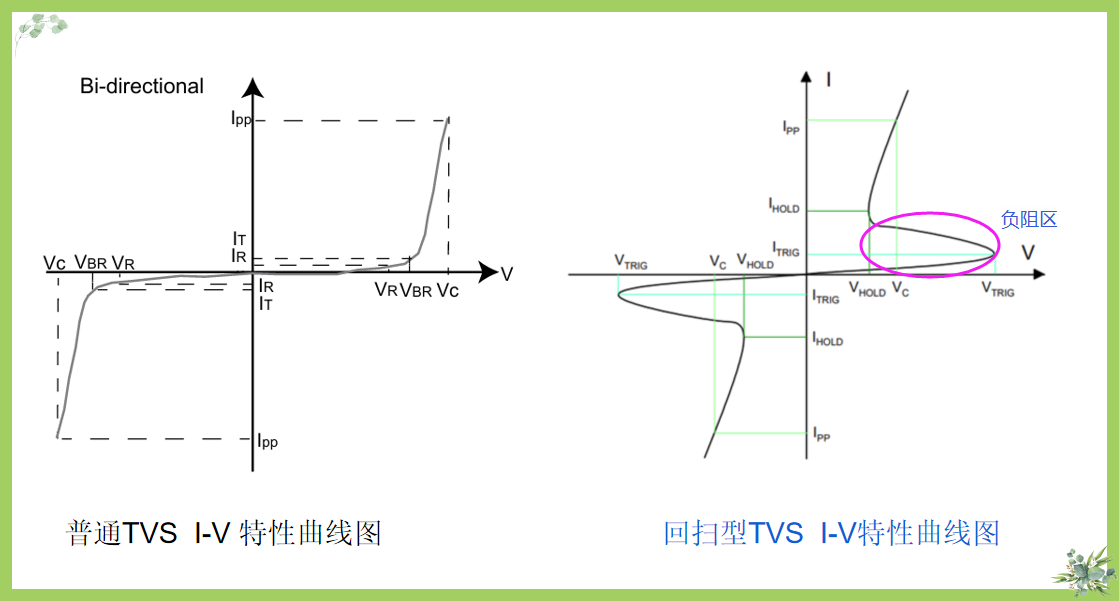
The伏安 characteristic curve of a common TVS looks like a symmetrical "Z" shape, while the curve of a sweep-type TVS is more like an "S" shape. The key difference lies in the negative resistance region.
二、The core of the problem: The conflict between the switch's instantaneous action and the negative resistance characteristic.
When the sweep TVS is used for the input terminal of the switching power supply, a hidden risk is triggered at the moment the system is powered on.
1. Startup characteristics of the switching power supply: When the switching power supply is turned on and closed, at the instant of power-on, the filter capacitor (large capacitance electrolytic capacitor) at the input end acts as a short circuit, resulting in a huge surge charging current. Although this current lasts for a very short time, its peak value can be as high as several tens or even hundreds of amperes.
2. Investigation of the negative resistance effect of TVS: The scanning characteristic is fundamentally derived from the negative temperature coefficient (NTC) effect of the TVS chip under extremely high current. At extremely high current density, the heating of silicon material leads to a sharp increase in carrier concentration, resulting in a "negative resistance" characteristic: the larger the current, the smaller the dynamic resistance, thereby causing the clamp voltage (Vc) to decrease.
3. Hazardous Coupling:
At the moment the system is powered on, the huge charging current surge of the capacitor may accidentally trigger the breakdown of the back-ward scanning TVS.
Once triggered, this current surge will immediately activate the negative resistance characteristic of the TVS diode, causing the clamping voltage Vc to drop sharply.
Key point: This sudden drop in Vc value could potentially be lower than the maximum rated voltage of the power devices within the switching power supply (such as the Vds of a MOSFET), or even lower than the normal operating voltage range of the power supply.
三、The dangerous "latch-up" effect
Now, let's look at the most dangerous situation: the clamping voltage is lower than the normal operating voltage of the power supply.
Suppose a sweeping-type TVS is used to protect a +5V power line.
Normal situation: A +10kV static pulse (or surge pulse) strikes, the TVS is broken down, and the voltage is clamped. After the pulse energy is dissipated, the voltage drops back to 5V, and the TVS should automatically return to the high-resistance state.
Abnormal condition (equivalent to short circuit): If the sweep voltage of this TVS is +3V, which is lower than the operating voltage of +5V
Step 1: A surge of electricity causes the TVS to break down.
Step 2: TVS enters the negative resistance region, and the voltage across its terminals drops from the breakdown voltage (such as 6V) and stabilizes at 3V.
Step 3: The surge pulse has passed, but the +5V power supply of the circuit is still providing power continuously.
Step 4: At this point, the voltage at both ends of the TVS is 3V, while the power supply needs to maintain a voltage of 5V. This creates a voltage difference. To maintain this voltage difference, the power supply will continuously inject current into the TVS.
Step 5: Since TVS is still in the low-resistance state after being turned on, this current will be extremely high and will always be higher than the sustaining current for the sweep.
Step 6: Result: The TVS diode cannot be turned off by itself. It behaves like a wire, continuously drawing a huge amount of current from the 5V power supply. This is the "latching" effect.
You can think of it as a switch that cannot automatically spring back: The surge pushed the switch down (causing a breakdown), but because the spring (returning characteristic) is too soft, the switch gets stuck in the "ON" position and cannot spring back to the "OFF" position, resulting in the continuous flow of current.
四、Why is it called "equivalent to a short circuit"?
In this "locked" state:
Impedance is extremely low: The dynamic resistance of TVS can be as low as a few ohms or even lower.
Extremely high current: According to Ohm's Law I = V/R, even a very small voltage difference (such as 5V - 3V = 2V) divided by a very small resistance will generate a continuous current of amperes. This current is greater than the maintained current for retention, and will keep the TVS in the "retention" state and unable to recover, unless the current flowing in is lower than the maintained current.
The consequences are severe: This huge continuous current will generate a large amount of heat, resulting in:
The TVS itself would be damaged by overheating (if its power capacity is insufficient).
2. What's even worse is that if the TVS doesn't burn out immediately, it will become a huge load, causing the entire power system to fail and leading to abnormal power supply or even a system reboot.
Does not provide protection: When a real overvoltage occurs again, this TVS that is already in the conducting state may not be able to respond effectively.
五、Deep sweep and shallow sweep TVS
According to the size (depth) of the sweep, TVS can be divided into deep sweep and shallow sweep types.
Deep Scan TVS:
Definition: The deep backscattering negative resistance effect is strong, the voltage drop is large, and the backscattering voltage Vc is lower than the working voltage Vrwm. Only a very small current is needed to maintain the conducting state.
Advantages: The clamp voltage is extremely low, providing the highest level of protection for the downstream chips. It is particularly suitable for protecting advanced process chips with very low withstand voltages.
Disadvantage: High latch-up risk: Due to the very low backscanning voltage and the small sustaining current, if an error trigger occurs on the power line, the power voltage can easily provide more energy than its sustaining current, causing the TVS to remain conductive (short-circuited) until it is burned out.
Application scenario: Primarily used for protecting signal lines, especially those with very weak driving capabilities (such as high-speed data lines, radio frequency antennas). It is strictly prohibited from being used in circuits that can provide large currents, especially power buses.

Shallow sweep TVS
Definition: Weak negative resistance effect, small voltage drop amplitude, relatively high sweep voltage: usually higher than or close to the common operating voltage. The sustaining current is usually higher: a relatively larger current is required to maintain the conducting state.
Advantages: Strong anti-locking capability, high security: Due to the high backscanning voltage and large sustaining current, even if there is an accidental trigger, the normal circuit voltage is difficult to provide sufficient current to maintain its conducting state. Therefore, it can be automatically turned off more easily, and the system stability is better.
Disadvantage: The clamp voltage is relatively high: The protection performance is not as "powerful" as that of the deep sweep TVS.
Application scenario: It can be used in some situations where there is a high sensitivity to latch-up risk but also requires certain surge protection. For example: certain low-voltage, limited current-limiting power supply paths, or general I/O ports with not extremely demanding protection levels.
It is a very good compromise between the deep sweep and the ordinary TVS.
一、Notes for Using Scroll-Type TVS
Engineering Selection Suggestions
1. The primary question: Should it be the signal line or the power line?
Power cord / High drive circuit: Opt for shallow sweep or standard TVS. Stability is of utmost importance; avoid the risk of latch-up.
High-speed signal lines/weak driver circuit: Deep sweep TVS can be given priority consideration. By utilizing its extremely low clamp voltage, it can provide top-level protection for the expensive main chip. Moreover, due to the small driving current of the signal lines, the latch-up risk is naturally controllable.
2. Carefully read the data manual:
Be sure to examine the I-V curve graph. The curve from the deep sweep "scrapes" the valleys very deeply and steeply; the shallow sweep is relatively gentle. Confirm the magnitude of the maintained current and assess whether your circuit can provide more than this value in abnormal situations.
The deep reverse sweep-back type TVS is suitable for signal data lines (meeting the capacitance condition).
Light gray and regular TVS are suitable for use at the power port.
The shallow sweep type TVS diode, even if its clamping voltage Vc is higher than the operating voltage Vrwm, the "lockout" effect will not occur. We must, based on the TVS voltage model, consider various situations and conduct actual tests when placing it in the circuit. Because
Depending on the application of the circuit, there can be significant differences. It's not like "one chip conquers the world".
In summary, for the scanning-type TVS application, we need to select the type based on the actual circuit conditions.
Leiditech Electronics is committed to becoming a leading brand in electromagnetic compatibility solutions and component supply, offering products such as ESD, TVS, TSS, GDT, MOV, MOSFET, Zener, inductors, etc. Leiditech has an experienced R&D team that can provide personalized customization services based on customer needs, offering the best solutions to customers.