
Medical nursing bed full-link ESD and surge protection solution
With the accelerating aging of the population, electric nursing beds have become widely used medical electrical equipment in hospitals, rehabilitation centers, and home care settings for the elderly. As Class B application devices that come into direct contact with patients and provide posture adjustment and life-support functions, their electromagnetic compatibility (EMC) is directly related to patient safety and the essential performance of the equipment.
Based on the current medical device registration standard YY 0505-2012 and the standards to be fully implemented from 2026, including GB 9706.103-2020, GB 9706.1-2020, and GB 4824-2019, nursing beds must pass stringent immunity tests such as electrostatic discharge (ESD), electrical fast transient/burst (EFT), and surge. According to NMPA medical device registration statistics, ESD and surge are the primary causes of EMC non-compliance, accounting for over 65% of failures, often leading to serious risks such as device malfunction, communication interruption, and motor runaway. In this article, the EMC engineer from Shanghai Leiditech will start from the safety requirements of medical devices, systematically analyze the electrical architecture and EMI/EMS risks of nursing beds, propose a full-link ESD and surge protection solution covering power supply, motors, human-machine interface, sensors, and Ethernet ports, and provide medical-grade component selection and design guidelines, offering technical references for enterprises to quickly pass registration tests and ensure patient safety.
I. Functional Structure and Electrical Architecture of Medical Nursing Beds
1.1 Core Functions and Medical Safety Features
Electric nursing beds integrate mechanical transmission, motor drive, embedded control, human-machine interaction, and health monitoring modules. Their core functions include:
· Position adjustment: backrest rising/lowering, legrest rising/lowering, overall height adjustment, and left/right lateral tilt.
· Human-machine interaction: handheld controller, bedside buttons, and remote communication interface.
· Safety mechanisms: electric side rails, emergency stop button, overload/power-off protection, and anti-entrapment detection.
· Auxiliary nursing features: bedpan opening, IV pole, and drainage hook.
· Health monitoring: sensors for heart rate, blood oxygen, body pressure distribution, and sleep quality.
Nursing beds fall under Class B applied parts that are in continuous contact with patients. EMC anomalies can lead to hazards such as unintended turning, sudden motor stop, uncontrolled position adjustment, emergency stop failure, and energized enclosure. Therefore, protection design must ensure: no harm to the patient after disturbance, predictable failures, controllable functional degradation, and recoverable reset.
1.2 Electrical System Block Diagram
The system consists of an AC/DC power supply unit, a main control MCU, a motor drive unit, a human-machine interaction unit, a sensor acquisition unit, and a communication interface unit.

1.3 Main Electrical Interfaces and EMC Risk Analysis
(1) Electrostatic Discharge (ESD) Risks
When medical staff or patients come into contact with the handheld controller, buttons, metal side rails, USB ports, or Ethernet ports, static electricity of ± several thousand to ± tens of thousands of volts can be generated, potentially causing:
· MCU reset or program runaway.
· Button false triggering or communication interruption.
· Motor false start or uncontrolled tilting.
· Sensor data glitches or health monitoring failure.
(2) Surge Risks
· External: grid fluctuations, lightning-induced surges, and start/stop of high-power equipment, coupling into the AC220V or DC24V power supply.
· Internal: back EMF generated by motor start/stop and inductive load voltage spikes.
· Consequences: damage to the power supply module, burnout of driving MOSFETs, complete system power loss, emergency stop failure, insulation breakdown, and excessive leakage current.
(3) Electrical Fast Transient/Burst (EFT) Risks
Switching of inductive loads on the power grid generates high-frequency bursts, which can cause control logic disruption, incorrect limit position detection, and sensor drift.
II. Applicable EMC Standards and Test Levels for Medical Nursing Beds
2.1 Core Standard System (Mandatory for Registration)
· YY 0505-2012: Medical electrical equipment – Part 1-2: General requirements for safety – Collateral standard – Electromagnetic compatibility – Requirements and tests (identical to IEC 60601-1-2:2004, current basis for registration).
· GB 9706.103-2020: Medical electrical equipment – Part 103: Electromagnetic compatibility – Requirements and tests (identical to IEC 60601-1-2:2014, mandatory from 2026).
· GB 9706.1-2020: Medical electrical equipment – Part 1: General requirements for basic safety and essential performance.
· GB 4824-2019: Industrial, scientific and medical equipment – Radio-frequency disturbance characteristics – Limits and methods of measurement (identical to CISPR 11:2016).
2.2 Electrical Fast Transient/Burst Immunity Test
Household electric bed (IEC 61000-4-4)
|
Test Ports |
Test voltage (kV) |
Pulse repetition frequency (kHz) |
Test duration |
Performance criteria |
|
Power ports |
±1 kV / ±2 kV |
5 kHz / 100 kHz |
60 seconds per polarity |
Performance criterion B is acceptable |
|
Signal/control ports |
±0.5 kV / ±1 kV |
5 kHz / 100 kHz |
60 seconds per polarity |
Performance criterion B is acceptable |
电动医疗床(IEC 60601-1-2)
|
Test Ports |
Test voltage (kV) |
Pulse repetition frequency (kHz) |
Criteria for assessment |
|
Power ports |
±2 kV |
5 kHz |
Criterion A must be met |
|
Signal ports |
±1 kV |
5 kHz |
Criterion A must be met |
2.3 Detailed Limits for Conducted Disturbance
|
Frequency range |
CISPR 11 / CISPR 14-1 limits (dBμV) |
FCC Part 15 limits (dBμV) |
|
150 kHz ~ 500 kHz |
QP:79,AV:66 |
QP:66 ~ 56* |
|
500 kHz ~ 5 MHz |
QP:73,AV:60 |
QP:56 |
|
5 MHz ~ 30 MHz |
QP:73,AV:60 |
QP:60 |
2.4 ESD Immunity Test
|
Equipment type |
ESD test standard |
Remarks |
|
Household electric bed |
IEC 61000-4-2 / EN 61000-4-2 |
General electronic equipment standard (applicable for CE certification) |
|
Household electric bed |
IEC 60601-1-2 |
Specific to medical devices, more stringent than general standards |
|
Export to the U.S. market |
ANSI C63.16 (references IEC 61000-4-2) |
May have additional requirements for FCC certification |
Household electric bed (IEC 61000-4-2)
|
Test items |
Test voltage |
Number of discharges |
Performance criteria |
|
Contact discharge |
±4 kV (on metal parts) |
10 discharges per polarity |
Temporary functional anomalies are acceptable (Criterion B) |
|
Air discharge |
±8 kV (on insulated surfaces) |
10 discharges per polarity |
Damage not allowed (Criterion D = non-compliant) |
Electric medical bed (IEC 60601-1-2)
|
Test items |
Test voltage |
Number of discharges |
Performance criteria |
|
Contact discharge |
±6 kV (on metal parts) |
10 discharges per polarity |
Functional interruption is not allowed (Criterion A/B) |
|
Air discharge |
±8 kV (on insulated surfaces) |
10 discharges per polarity |
Life-support equipment requires a ±2 kV margin |
2.5 Limits for Radiated Disturbance
|
Standard |
Equipment class |
Frequency range |
Limit (dBμV/m) |
Test distance |
|
CISPR 11 |
Industrial/Scientific/Medical (Class A) |
30 MHz~230 MHz |
QP:40 |
10m / 3m* |
|
|
|
230 MHz~1 GHz |
QP:47 |
230 MHz ~ 1 GHz |
|
CISPR 32 |
Household (Class B) |
30 MHz~230 MHz |
QP:30 |
3m |
|
|
|
230 MHz~1 GHz |
QP:37 |
|
|
FCC Part 15 |
Class B (Household) |
30 MHz~88 MHz |
40.0 |
3m |
|
|
|
88 MHz~216 MHz |
43.5 |
|
|
|
|
216 MHz~960 MHz |
46.0 |
|
|
IEC60601-1-2 |
Medical device |
30MHz~6 GHz |
Reference CISPR 11 Class B |
3m |
|
Note: CISPR 11 permits testing at 10m, but 3m is more common (limit conversion required: 10m limit = 3m limit + 10dB). |
||||
III.Full-Link ESD and Surge Protection Solution
3.1 Basic Principles of Protection Design
1. Risk-graded protection:
High risk: Handheld controller, bedside buttons, metal side rails (frequent patient contact) → 30kV-grade redundant protection.
Medium risk: Motor drive, sensors, communication interfaces → 20kV-grade redundant protection.
Low risk: Internal debug ports, non-patient-contact ports → 15kV-grade redundant protection.
2. Three-stage surge architecture: GDT (primary discharge) + MOV (secondary clamping) + TVS (tertiary fine clamping).
3. Grounding first: Protective earth, functional ground, and patient ground must be strictly separated, with short, thick, and straight discharge paths.
4. Leakage current control: Patient-accessible enclosure leakage current ≤ 0.1mA (YY 0505).
5. Hardware + software coordination: Hardware suppresses interference, while software provides validation, redundancy, and reset protection.
3.2 AC220V Power Input Protection Scheme (Common mode ±4kV / Differential mode ±2kV)
The AC220V power input is the primary path for surge intrusion and requires a multi-stage protection scheme. The EMC engineer from Leiditech recommends selecting protection devices of different levels based on the environment in which the power supply operates, to meet IEC61000-4-5 test levels from 4KV to 8KV. According to IEC 60601-1-2, the power port of medical equipment must withstand ±2kV differential mode surge and ±4kV common mode surge testing. Leiditech adopts a GDT + MOV combination to discharge the surge.

3.3 DC24V Motor Drive Power Protection Scheme (Common Mode ±2kV / Differential Mode ±1kV)
This power supply is used to drive motors for bed lifting, turning, and other functions. During start and stop, the motors generate back EMF and are also subject to surge stress on the power lines. The DC power interface is used to connect an external 12V/24V DC power supply or battery for mobile use. This interface also faces threats from surge and electrostatic discharge, and must meet the requirements of IEC 61000-4-2 ±8kV contact discharge and ±15kV air discharge.

Leiditech recommends using a GDT and MOV as the primary surge protection stage to discharge high-energy surges, with a TVS as the secondary fine protection stage to clamp the voltage within a range tolerable by the downstream circuit. A common mode choke is also used to suppress common mode interference on the DC power lines.
3.4 ESD Protection for Handheld Controller RS485 Interface
The handheld controller is the most frequently used human-machine interface and the primary entry path for electrostatic discharge. Handheld controllers typically use an RS485 communication interface:
ESD protection solution for RS485 interface:

The EMC engineer from Leiditech recommends using multi-channel integrated devices for protection, which ensures signal integrity while filtering out noise and passing ESD testing. It meets IEC 61000-4-2 Level 4, with contact discharge of 30kV and air discharge of 30kV.
3.5 ESD Protection Solution for RS232 Interface

The RS-232 standard interface, also known as EIA RS-232, is one of the commonly used serial communication interface standards, typically applied in short-distance point-to-point communication. On communication equipment, this interface serves as a debug interface, an inter-board communication interface, and a monitoring signal interface, with a maximum data rate of 115,200 baud.
Leiditech recommends using the integrated components SMC12/SMC15 for protection, which ensure signal integrity while passing ESD testing. They meet IEC 61000-4-2 Level 4, with contact discharge of 30kV and air discharge of 30kV.
3.6 ESD Protection Solution for USB Interface
Some high-end medical nursing beds are equipped with a USB interface for data transmission and firmware updates.

Leiditech recommends using USB 2.0, which provides a transmission speed of 500 Mbps. This solution uses a single device for protection, saving space, ensuring signal integrity, and filtering out common mode interference. The SR05 meets IEC 61000-4-2 Level 4 with contact discharge of 20kV and air discharge of 20kV. The SR05W meets IEC 61000-4-2 Level 4 with contact discharge of 30kV and air discharge of 30kV, offering 7 times higher performance to handle various electrical disturbances in industrial applications. If overcurrent protection is required for Vbus, a PTC should be added.
3.7 ESD Protection Solution for Gigabit Ethernet Port

Leiditech recommends using the multi-channel integrated component ULC332010T8 for Ethernet port ESD protection. This solution balances signal integrity and space optimization, meets IEC 61000-4-2 (Level 4) standards, and supports both contact discharge and air discharge of ±30kV.
3.8 Protection Solution for RF Antenna Module
Leiditech provides ESD protection for antenna interfaces with ultra-low capacitance to ensure signal integrity. It supports contact discharge of 30kV and air discharge of 30kV. If IEC 61000-4-5 surge testing is required, a GDT component should be placed at the front end.

3.9 Protection Solution for Sensors
Leiditech uses the S1M and GBLC24C to protect sensitive sensor chips powered by conventional 4-20mA 24V supplies. Advantages of this solution include small package, low capacitance, and high current protection. It meets IEC 61000-4-2 Level 4, with contact discharge of 30kV and air discharge of 30kV.
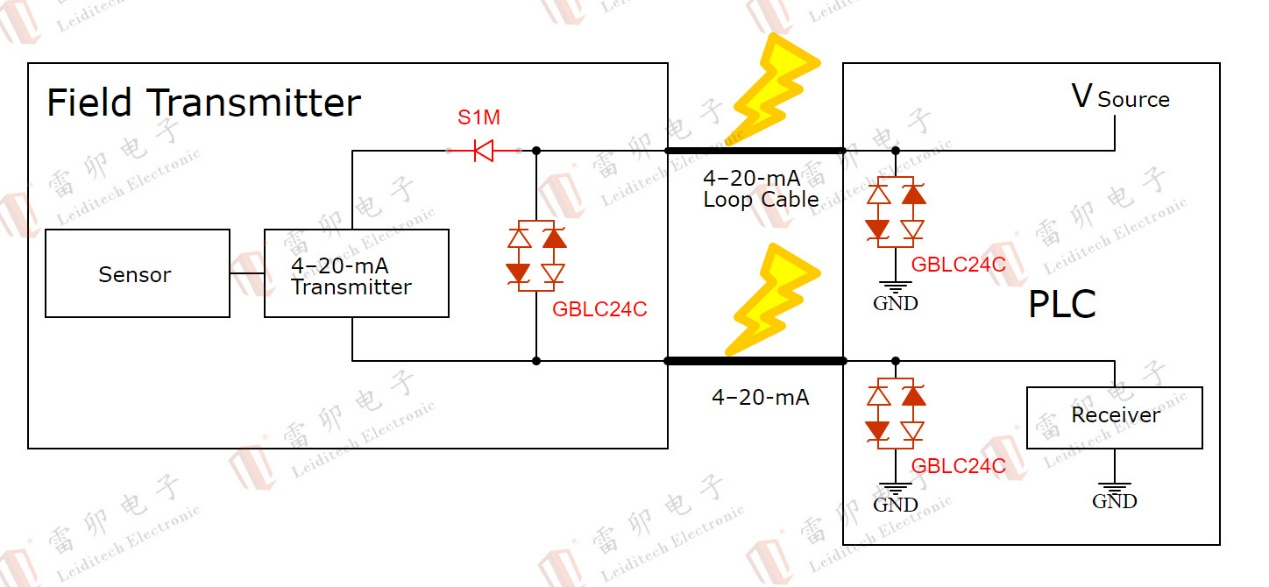
The models and key parameters of all Leiditech protection components used in this solution are summarized as follows:
|
Application location |
Model number |
Type |
Key parameters |
|
AC 220V power protection |
14D471K |
MOV |
470V,Bidirectional,4500A |
|
AC 220V power protection |
20D471K |
MOV |
470V,Bidirectional,6500A |
|
AC 220V power protection |
25D471K |
MOV |
470V,Bidirectional,15000A |
|
AC 220V power protection |
2R600-8L |
GDT |
600V,Bidirectional,10KA |
|
DC 24V power supply |
SMBJ26CA |
TVS |
26V,Bidirectional,600W |
|
USB 2.0 interface |
SR05 |
ESD |
5V,1.5pF,Three-channel |
|
RS232 interface |
SMBJ6.5CA |
ESD |
6.5V,600W,Bidirectional |
|
RS232 interface |
SMC12 |
ESD |
12,Bidirectional,15A |
|
RS485 interface |
SM712 |
ESD |
7/12V,Bidirectional,45pF,17A |
|
Gigabit Ethernet ESD protection |
ULC332010T8 |
ESD |
3.3V,Bidirectional,30A |
|
Buttons |
ULC0524P |
ESD |
5V,0.6pF,Four-channel |
|
Antenna protection |
ULC0511CDN30 |
ESD |
5V,Bidirectional,0.22pF,5A |
|
Sensor protection |
GBLC24C |
ESD |
24V,Bidirectional,1pF,8A |
As a critical medical device directly related to patient safety, the EMC protection design of medical nursing beds is of paramount importance. With over 16 years of experience in the R&D and application of protection components, Shanghai Leiditech deeply understands the special requirements and standard demands of the medical industry, providing a full-link ESD and surge protection solution for medical nursing beds — from power supply to interfaces.
Leiditech not only provides high-quality protection components but also has a professional EMC laboratory and technical team, offering customers free EMC testing, solution optimization, and rectification services. The Leiditech EMC engineer is always available to answer your technical questions related to EMC protection, helping your products quickly pass medical EMC standard tests, successfully complete product registration, and be brought to market as soon as possible.